
How Companies Can Effectively Protect Themselves Against DDoS Attacks
The Digital Weakness of Small and Medium-Sized Businesses – When the Digital Lifeline Suddenly Stops Flowing
Imagine that your website becomes inaccessible in the middle of peak season, your customer portal stops working, or the business-critical API interface with your suppliers goes down. In a fully interconnected B2B world, the constant availability of digital infrastructure is no longer a luxury but an absolute prerequisite for business success. Yet it is precisely this availability that is increasingly becoming a target for cybercriminals.
Among the numerous threat scenarios, so-called distributed denial-of-service (DDoS) attacks have become one of the most devastating and, at the same time, most easily scalable weapons. The threat landscape is constantly growing: Statistics show that half of all German companies have already been affected by such overload attacks. To effectively counter this threat, we at PFALZKOM – in cooperation with the German security specialist Myra Security – are expanding our portfolio with the next crucial component: our PFALZKOM DDoS Protection. But what exactly happens during such an attack, and who urgently needs professional protection?
A Large-Scale Digital Attack Explained: What Does DDoS Actually Mean?
A DDoS attack is, at its core, an artificially induced digital flood. Unlike a simple “Denial of Service” (DoS) attack, which originates from a single computer, DDoS attacks are “distributed.” Cybercriminals use massive, often global botnets – networks of thousands of infected computers, IoT devices, or servers that are remotely controlled without their owners’ knowledge.
The goal of these attacks is not to steal data. Rather, the aim is to bring the IT infrastructure – whether a web server, firewall, or network connection – to its knees or to divert its attention through a sheer volume of manipulated requests. The resources of the targeted system are completely exhausted.
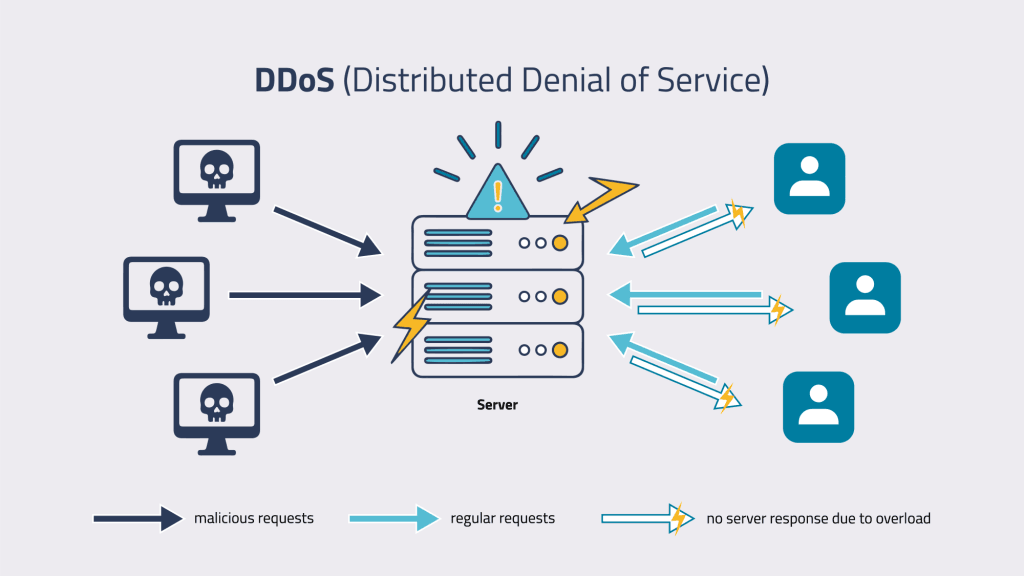
As the chart illustrates, the flood of malicious requests causes the server to run out of capacity for legitimate data streams. For your customers, partners, and employees, this means: The page won’t load, transactions fail, and the system is “down.”
The Evolution of Attacks: Why Traditional Firewalls Fail
In the past, DDoS attacks were mostly purely volumetric attacks on the lower network layers (Layers 3 and 4) that simply clogged the Internet connection with data. Today, however, IT security experts are observing a dangerous shift: attacks at the application layer (Layer 7) are increasing rapidly.
These attacks on the outermost network layer perfectly mimic the behavior of real human users. For example, they repeatedly trigger computationally intensive search functions on a website or send slowed-down requests that silently overload the server. Since this traffic appears completely legitimate at first glance, standard firewalls or simple routers are usually unable to handle it. Three out of four companies fail to defend against these complex application-layer attacks because they lack the necessary filtering technologies.
While traditional protection secures the infrastructure at the network level (Layers 3 and 4), attacks at the application level (Layer 7) require a more in-depth analysis. This type of Layer 7 protection can be planned and implemented directly for your web applications, regardless of your network connection. A highly intelligent filtering system (known as a scrubbing center) masks your digital interfaces. Malicious traffic is detected and blocked fully automatically, while valid user requests reach your systems without any noticeable delay. This makes your servers much harder for attackers to target.
Focus on Target Audiences: Who Needs PFALZKOM DDoS Protection?
These threats are no longer limited to global tech companies or major banks. Any company whose business processes depend on a reliable Internet connection is a potential target. With its new security solution, PFALZKOM is specifically targeting four core groups in the B2B sector:
- Digitalization of Small and Medium-Sized Businesses & E-Commerce: Whether it’s a standard website, a customer portal, or a digital CRM system, if small and medium-sized businesses aren’t accessible online, impatient users will immediately turn to the competition. In addition to direct revenue losses, this poses the risk of lasting damage to their reputation and requires significant resources to restore customer trust.
- Critical Infrastructure (KRITIS) & Government Agencies: Municipal utilities, energy providers, logistics companies, and healthcare facilities bear a special responsibility toward the public. A failure of their systems can have serious consequences. In addition, public administrations and the KRITIS sector are increasingly under constant, politically motivated attack. Our product is based on KRITIS-proven technology certified by the Federal Office for Information Security (BSI) that meets the strictest legal requirements.
- Companies subject to the NIS 2 Directive: With the tightening of the European cybersecurity directive (NIS 2), far more companies than before are legally required to demonstrate ongoing risk management measures and the maintenance of their operational resilience. A lack of DDoS protection can lead to severe penalties and personal liability risks for management in the event of successful attacks.
- B2B customers with smaller, dedicated IT infrastructures: A major technological advantage of the PFALZKOM solution compared to pure global cloud providers is that traditional protection solutions often only work for networks of a certain size or larger. Thanks to our unique infrastructure, we can provide full DDoS protection to all our customers. This finally makes professional IT security affordable and feasible for smaller companies and custom architectures as well.
Integration: Maximum Protection without Investment Risk
A key advantage for B2B decision-makers: PFALZKOM DDoS Protection is provided exclusively as Security-as-a-Service (SaaS). For your company, this means that no investment in expensive additional hardware or software licenses is required.
The cloud-based and hybrid architecture enables integration that is as simple and fast as possible. The implementation is tailored precisely to your technical requirements and specific security needs, as we distinguish between two technologically independent protection methods. Together with our regional network specialists, our partner Myra, and in close coordination with your IT team, we define the exact filter rules that are perfectly tailored to your business-specific data traffic and the respective protection class.
Conclusion: Unfortunately, the question today is no longer whether a company will be attacked, but when. With its new DDoS protection, PFALZKOM offers regional small and medium-sized businesses and critical infrastructure a level of security that was previously reserved only for large corporations.
Interested in learning more? Our experts would be happy to work with you to analyze your existing infrastructure and develop a comprehensive and reliable security plan. Please contact us!